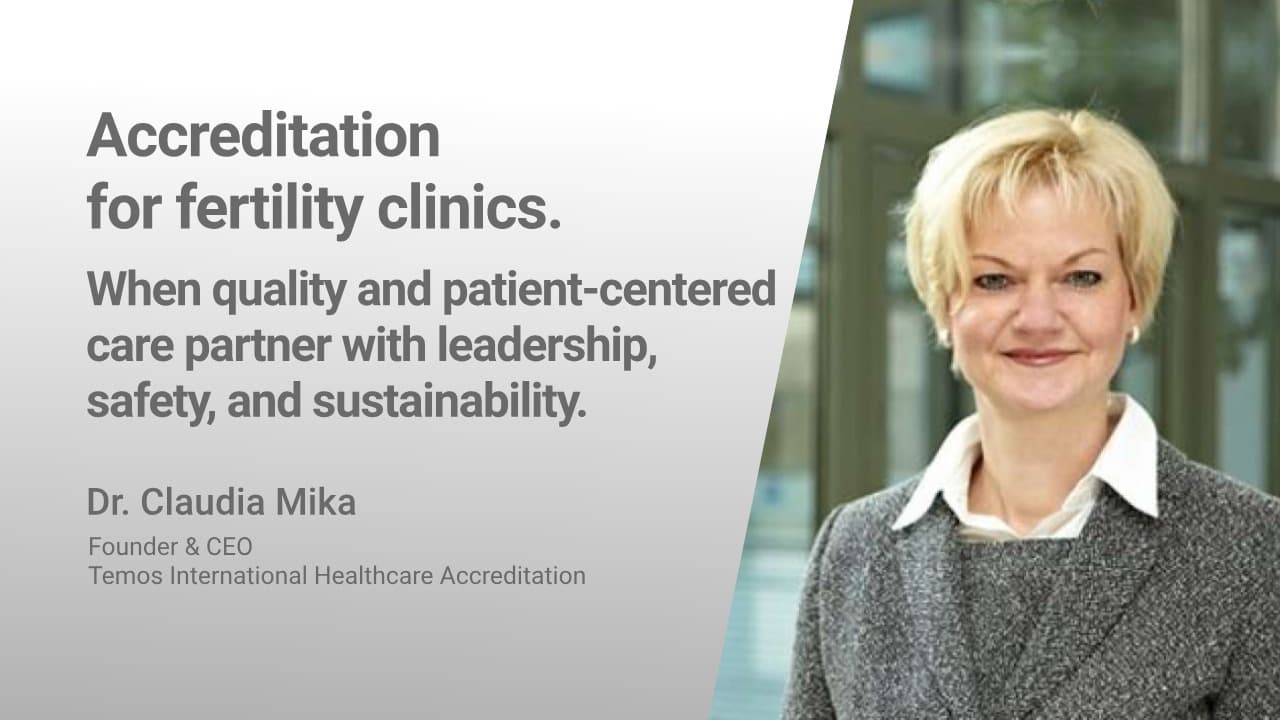
Dr. Claudia Mika is the Founder and CEO of Temos International Healthcare Accreditation, a German-based international accreditation body that assesses hospitals, clinics, rehabilitation centers, reproductive care centers, and dental clinics worldwide. Today we bring you the article from Dr. Mika on quality of IVF clinics and patient-centred approach that partner with leadership, safety, and sustainability.
Fertility clinics have been largely ignored by international accreditation organizations, preferring to treat them the same as general ambulatory care centers. This approach ignores the specific clinical and laboratory services unique to reproductive care as well as the elements of the patient experience that IVF clients require. In 2019, Temos introduced its accreditation program for reproductive care centers to fill the need for specialized standards for IVF clinics and the clients they serve. Here is why accreditation plays an essential role in improving the quality of care delivered by IVF clinics and reproductive care centers.
Accreditation has a clear mission to improve the overall quality of healthcare and patient experience services offered by a clinic or hospital. Accreditation itself is a process that sets out best practices called “standards” that the clinic or hospital must demonstrate that it satisfies through a review process by the accreditation organization. These standards are based on scientific research, well-established best practices, experience, as well as innovation. It is a cooperative, voluntary process between the accreditation organization and the clinic or hospital to enable the healthcare provider to maximize its capabilities as well as a commitment to continuous quality improvement.
To demonstrate how the accreditation process works, let us look at two examples of the journeys of two different fertility clinics in different environments.
Watch the webinar “How to check the quality standards of IVF clinics”
Building on its strength: Fertility Clinic A
Fertility Clinic A has a strong international reputation in that it attracts clients from within the country as well as internationally. It is located in a country that has a positive brand as a safe tourism destination with a stable political system. Clinic A is busy serving patients, contributes to international science and research, and is financially successful. The clinic has been growing fast, with patient and staff numbers increasing.
The Managing Director realizes that when the team was small, communication was easy, and people knew what to do. During the last months with more patients and new staff, the number of complaints has increased. Staff members complain about long working hours plus they do not feel comfortable and sufficiently trained to deal with the different cultures they encounter every day. Common complaints from patients include long waiting times and unfriendly staff. It is time for a business intervention.
The Medical Director who reports directly to the owners is responsible for clinical outcomes and patient complaints is not happy with the new numbers being reported. The owners and Medical Director agree that the Clinic will function better with happier staff and patients if medical, clinical, and laboratory processes and procedures are standardized, followed, measured, reviewed, and improved.
Instead of engaging one or more consultants, the Medical Director and the owners decide to apply for accreditation as a holistic approach to receiving guidance by the accreditation standards and accompanying tools for self-assessment and the requested support for the re-structuring of the Clinic.
Temos standards address topics such as “medical services”, “assisted reproductive technology laboratory”, and “outcome and effectiveness”, “management of human resources”, “leadership”, “international patient management”, and “quality management” to help the Managing Director and staff review their current approaches to service delivery and paths forward to improve those services.
After successfully completing the accreditation process, Fertility Clinic A meets and exceeds its goals for clinical outcomes, patient satisfaction as part of the patient experience, revenue, and other indicators.
As an unexpected but much appreciated added value staff members reported after the onsite visit that cross-departmental team meetings that were implemented to work on the standards during the preparation, were of great value and motivation to all and are continued since then.
Fulfilling its vision: Fertility Clinic B
Fertility Clinic B, located in a CIS country, is well known nationally. It is busy but has the capacity to serve more patients. The Clinic is managed and owned by the same person, an ethical and quality-oriented CEO. Her vision is to become a state-of-the-art fertility clinic that can compete on the international level. She wants to ensure that the Clinic has the same standards for clinical outcomes, laboratory services, infection prevention, and non-clinical services to make it a regional destination for infertility treatment services.
Clinic B’s technical infrastructure and laboratory equipment are adequate and well-maintained. Due to language barriers, regular training and education programs from international sources are limited, preventing the Clinic’s team from meeting their goals for numbers of procedures as well as clinical outcomes. The CEO looks at the available resources to help her and her team achieve her vision for Clinic B.
The CEO contacts Temos to start the application process for international accreditation to become the first accredited fertility clinic in the country. The staff is excited and afraid at the same time, not sure of what to expect. Step by step, the accreditation standards are translated, and assistance provided to help Clinic B implement the standards. Temos headquarters, as well as its CIS regional office, works with Clinic B each step of the way. Quality management and documentation system are implemented based on defined outcomes, assigned responsibilities, and more. Processes and procedures are compared to international state-of-the-art standards and adjustments and improvements made as needed.
Regular training and education take place so that staff becomes familiar and comfortable with the new way of delivering services. As a result of these efforts, Clinic B successfully passes the accreditation and celebrates its accomplishment with a big party. Then it launches marketing to promote its achievement. It is ready to welcome more domestic clients as well as its first international patients.
Watch the webinar “How to check the quality standards of IVF clinics”
The accreditation journey
Accreditation is an ongoing story, engaging all staff members in the continuous quality and service improvement of the clinic. This journey improves the quality and efficiency of the clinical and non-clinical services resulting in measurably better outcomes to benefit its clients, employees, and owners.
The Temos accreditation process starts with a simple registration process followed by an agreement that is signed. Then the hard work begins. Our clients receive access to the secure and private online platform, the standards, and accompanying online self-evaluation tools. The self-evaluation process enables the clinic to view its progress as it demonstrates systems and processes that meet each standard. The Temos team helps when needed. When the client indicates readiness for assessment, the client and Temos assessment team prepare for the onsite visit.
The Temos on-site visit is conducted by a team of experts, typically a clinician such as a doctor or an embryologist as well as an expert in quality management. Temos has a team of culturally diverse, multi-lingual, highly qualified assessors with experience in more than 100 countries. The assessor team shares its knowledge and experience while exercising cultural sensitivity when evaluating each clinic.
Following the on-site visit, suggestions or recommendations are made to improve services to fully comply with the standards. The accreditation is awarded. It is valid for three years; however, once a year, clients deliver updates to confirm continuing compliance with the standards as well as to report any major changes to services or governance.
Accreditation: Confirmation of international excellence
During the COVID-19 pandemic and moving forward into the future, clients increasingly expect that reproductive care services will be offered according to clinically accepted best practices. They look to accreditation to verify that the clinic is committed to excellent clinical outcomes, patient and staff safety, improved hygiene standards, an excellent patient experience, and more.
As we can see from the above examples: it is worth a try!
Aleksander Wiecki is Chief Marketing Officer of IVF Media and has worked in the fertility field since 2008, leading marketing and patient experience. He is Vice-Chair of the European Fertility Society, Chair of its Cross Border Reproductive Care Committee, and a member of ESHRE. Read full bio
Need help choosing an IVF clinic abroad?
Take 3 minutes to complete our Clinic Matching Test and save yourself hours of searching, comparing, and contacting clinics on your own. Tell us what matters most to you — your treatment type, destination preferences, expectations, and personal situation — and we will match you with 3 trusted IVF clinics abroad that fit your needs.
Our database includes only experienced fertility clinics that regularly support international patients and understand what matters during treatment abroad: clear communication, transparent information, patient care, and professional support.
The selected clinics will contact you directly within 3 working days, so you can compare your options and take the next step with more confidence.
Exclusive Clinic Interview with Dr. Maria Arqué | Fertty International
We have talked to dr. Maria Arqué, a physician specialised in Obstetrics and Gynecology and International Medical Director at Fertty International, Barcelona, Spain. Dr. Arqué has a doctorate in Medicine (Ph.D.) from the University Autònoma de Barcelona on Reproductive Medicine conducting a pilot study on the influence of diet and lifestyle on the results of […]
Egg Donation in Greece: Costs, Donors, Age Limits & IVF Rules
Greece is unusual among European IVF destinations for two reasons: women can receive medically assisted reproduction up to 54 years of age, and Greek law now allows more than one donor-identity model. Women over 50 require authorization from the Greek National Authority for Medically Assisted Reproduction (EAIYA), while donor treatment may involve an anonymous donor, […]
Egg freezing – all you need to know | Interview with Prof. Luciano Nardo
When it comes to female fertility, age is of paramount importance. As women get older, their oocytes diminish in numbers and in quality and this brings problems with natural conception. That is why egg freezing seems to be a perfect solution that helps pause the biological clock. We have interviewed Prof. Luciano Nardo, Clinical Director […]
Exclusive Clinic Interview with dr. Visnova, IVF CUBE (Czech Republic)
CUBE IVF Prague, infertility centre from the Czech Republic was opened in 2011. EggDonationFriends have interviewed Dr. Hana Visnova, who is a medical director and owner of IVF CUBE. Dr. Visnova has more than 17 years of experience in the area of assisted reproduction. EggDonationFriends know that patients love short, content-packed answers. That is why the […]
10 tips that will help you save money on IVF and other fertility treatments
Newest data shows that one in a seven couples have problems with fertility. Many of those couples decide to go for fertility treatments including IVF, egg donation ICSI and many others. The problem is that a big part of those infertile couples cannot afford treatments as expensive as IVF. Below you will find 10 tips that […]
Embryo Adoption vs. Double Donation: Which Treatment is Best for Me?
The search for motherhood and fatherhood can be an emotional and medical challenge. Spain has established itself as an international benchmark in reproductive medicine, thanks to advanced legislation on assisted reproduction and strict controls that guarantee the safety and efficacy of each treatment.
Exclusive Clinic Interview with dr. Nadia Caroppo | Equipo Juana Crespo
This month we are talking to dr. Nadia Caroppo, a Gynecologist and the Head of the International Medical Team at Equipo Juana Crespo, an IVF clinic from Valencia, Spain. Dr. Caroppo has 8 years of experience and speaks Spanish, English, Italian, and French. Can you tell us why patients from the UK or European countries […]
Patients’ Fertility Story in Czech Republic
My husband Jeff and I first started trying for children in 2012, a little over two years after we got married. After six months of trying unsuccessfully, my OB-GYN recommended that we consult with a reproductive embryologist, as I was 38 years old. At the time we were fortunate to have insurance that would cover […]
Best Countries for IVF Revealed
Popular countries, costs, success rates, legal frameworks and availability in one comprehensive 100-page guide. 10K+ downloads