Exclusive Clinic Interview with dr. Nadia Caroppo | Equipo Juana Crespo
This month we are talking to dr. Nadia Caroppo, a Gynecologist and the Head of the International Medical Team at Equipo Juana Crespo, an IVF clinic from Valencia, Spain. Dr. Caroppo has 8 years of experience and speaks Spanish, English, Italian, and French.
Can you tell us why patients from the UK or European countries should consider Spain as their destination for fertility treatment abroad?
Spain is, in fact, the European country with the best IVF success rates given all the advances in the medical field and the high expertise of medical staff and embryologists, as well as high-quality standards in embryology labs which mark a clear difference in outcomes. Spanish IVF Law is one step ahead with respect to other countries, enabling the use of innovations in this field, and allowing treatments that other countries do not contemplate, such as egg/sperm donation or embryo donation. Our country, and especially Valencia, is a safe and pleasant destination for a holiday. This is important given that couples who come from abroad to perform IVF treatments undergo a lot of stress, so being in a welcoming country with lots of cultural and leisure activities, makes this path much easier.
Dr. Nadia Caroppo, Equipo Juana Crespo clinic, SpainEquipo Juana Crespo was established in 2016. What is your doctors and embryologists’ experience in the fertility field?
Dr. Juana Crespo is a pioneer in Assisted Reproduction Medicine in Spain with a worldwide renowned reputation. When she decided to provide her expertise in her own clinic, she personally selected all her staff to offer the best medical standards to her patients, which are reflected in the results we have. All the staff has extended experience in the human reproduction field.
Does your clinic specialize in a certain area, e.g. male factor or multiple IVF failures? Do you get many patients with these issues?
Our clinical activity is based on highly complex IVF treatments. We have extensive knowledge about the impact of age in egg quality and uterine functionality. We are experts in endometriosis, recurrent pregnancy losses, implantation failures and treating pathological uteri. For this reason, we offer a very personalised treatment strategy for each case.
We know from our experience that one of the reasons many couples avoid going abroad for IVF is a language barrier. Does your staff speak English and/or other languages?
Of course! Part of our staff speaks English, French, Italian and Dutch.
Is your clinic obliged to report the results and success rates to an international monitoring organisation like ESHRE? Where and how can a patient check if your clinic is fully accredited and regulated before deciding on treatment at Equipo Juana Crespo?
We report annually our results to the Spanish Fertility Society (SEF), which is similar to the Human Fertilisation & Embryology Authority (HFEA) in the UK, and to the Association for the Study of Human Reproduction (ASEBIR). Apart from these entities, our results have been audited and certified by an independent official entity.
Can you please tell us about the donor egg recipient qualification process and what patients cannot be accepted for egg donation treatment? Are there any limitations?
There are no limitations in terms of being accepted for an egg donation program, expect maternal age. There is a consensus amongst most clinics in Spain, including ours, to treat women up to 50 years of age. But, before advising couples to undergo an egg donation program, we make a thorough diagnosis of the cause of their infertility issues. Some couples who have undergone several egg donation treatments fail, and the cause may not be the embryos, but other issues. Therefore, we must investigate if the problem lies in a malfunctioning uterus and/or fallopian tubes, difficult embryo transfers, previous C-section scars that may cause problems in future pregnancies, bad receptivity of the endometrial lining, etc. All the above emphasizes the importance of a good diagnosis in the first place to have success. And part of this success is by personalising treatments.
Is donor-recipient matching obligatory in Spain? Also, you advertise that you have the following egg donor ethnicities available: Scandinavian, African (black), Asian, Indian, Arab? Are they available without waiting time?
The donor-recipient matching process consists of having a phenotypical match, immunological match (blood group and Rhesus factor) and genetic match. Spanish IVF Law contemplates that the donor and recipient must be phenotypically similar. In our case, we strongly suggest undergoing the genetic matching screening to rule out an important number of genetically inherited diseases. The immunological factor (Blood group and Rhesus factor) is not a sine-qua-non condition to undergo an egg donation program, given that there is evidence that being a recipient of an oocyte or a sperm with a different blood group does not increase the possibility of miscarriage.
Yes, we have different donor phenotypes available at our clinic, such as Arabic, African, or Scandinavian, amongst others, and including Asian, though this last one is scarce. We have a pool of donors who have already been studied and approved to enter our egg donation program. Therefore, the is nearly no waiting list to be a recipient.
Reception at Equipo Juana CrespoWhat is your protocol for patients with multiple IVF failures? Do they receive different treatment?
The key to our success rates is a thorough diagnosis of the couple’s cause of sterility. All our patients undergo personalised treatments in terms of increasing egg quality, controlled ovarian stimulation protocols, restoring uterine functionality with microsurgery and/or medical treatment, designing a good strategy for endometrial preparation and essaying embryo transfers beforehand. All the above explains the high success rates we have in patients who have had multiple IVF failures.
Do you consider egg donation the best alternative for patients aged 38-40? There are many patients of this age who are looking for treatment with their own oocytes.
We are specialised in motherhood over 40, both with own eggs and egg donation. Each woman’s ovary is different, and we need to understand its response and how to increase oocyte quality. Therefore, we must try everything before we give up on a patient’s ovary. We have had women over 44 years (exceptional cases) who have had perfectly normal babies with their own eggs after undergoing personalised protocols of controlled ovarian stimulation with preimplantation genetic testing. Nevertheless, we also have cases of very young women who underwent egg donation programs to become mothers.
We perform more than 1,300 IVF cycles with own eggs per year, with an overall positive pregnancy test rate of 65% per embryo transfer: 71.88% in women younger than 35 years of age; 69.34% in women between 35-39 years of age, and 59.24% in women older than 40. The pregnancy rate with the egg donation program is 74.25% and the average age of patients is 43. Our rates represent the result per embryo transfer, never cumulative rates.
Can you tell us, in short, about the most difficult IVF case you have had that ended in successful birth? What made a difference in that case?
We once received a patient who underwent IVF treatments in Germany, with a total of 7 embryos transferred, all of which failed. They counselled the couple to undergo an egg donation program: they transferred 15 embryos with no success. When we met the couple, first we studied their case thoroughly. The cause of all failures turned out to be a uterine factor and a very difficult embryo transfer. The patient then underwent a pelvic MRI + microinvasive surgery to remodel the uterine cavity, followed by further medical treatment to restore uterine functionality and we essayed how to properly perform a perfect embryo transfer. The result was a normal pregnancy after the first embryo transfer. This emphasizes that implantation failures can occur even in egg donation programmes. Our expertise resides in the understanding of why treatments fail, especially in malfunctioning uteruses.
Why are overseas IVF clinics such as Equipo Juana Crespo able to offer more affordable IVF and egg donation? In the UK, treatment is more expensive.
Our clinic does not offer fixed packs or fees for IVF or egg donation programs. What makes the difference is the custom-made treatment for each patient, which means that patients only pay for that which they really need. Our high personalisation is our key to success, and it explains the high pregnancy rates we have.
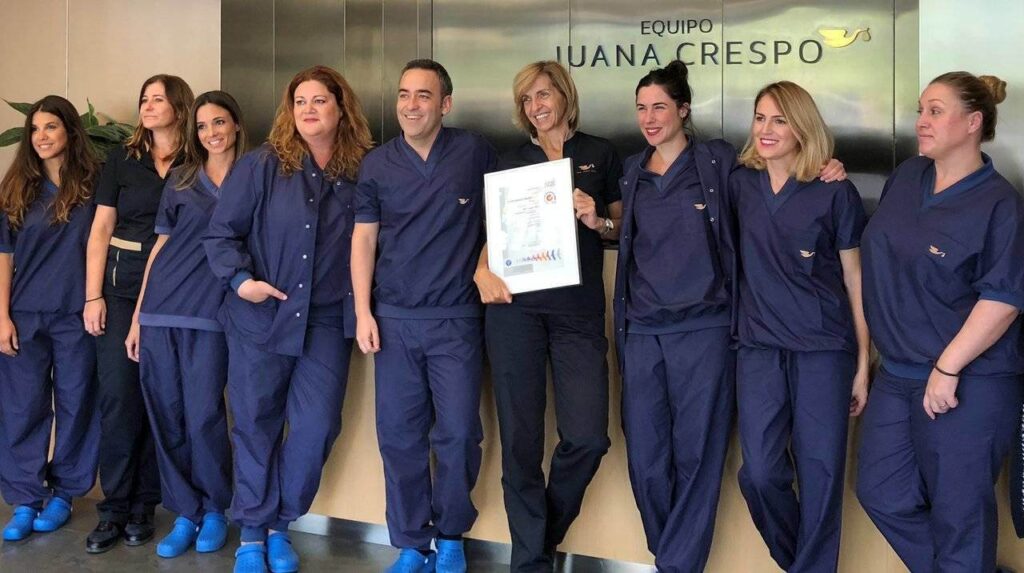
Equipo Juana Crespo IVF Clinic teamDuring the treatment process who is in touch with the patient? Can patients communicate with the doctor? Are they assigned an individual patient coordinator?
Each patient is assigned a patient care coordinator who will follow up all the process and coordinate the timing of the treatment. The coordinator will provide guidance with the protocols, send prescriptions and clear any doubt during the whole process. On top of that, we offer continuous medical care service during the clinic’s opening hours via email or over the phone. We also have an emergency phone service available 24h/365, in case any patient needs to contact us out of the opening hours.
Valencia, where your clinic is located, is also a stunning holiday destination – when is the best time to visit if patients want to have a holiday together with their treatment?
Valencia offers lots of leisure and cultural options. It is a small city, but with plenty of activities to do in the city or in the surrounding areas. The weather is very good all year round with mild winters. We have very nice beaches too! Nevertheless, the best time to visit the city is during springtime or fall.
If you wish to learn more about Equipo Juana Crespo clinic, their egg donation programs, doctors’ experience, availability of egg donors, take a look at their clinic profile and contact them to book a consultation.
Need help choosing an IVF clinic abroad?
Take 3 minutes to complete our Clinic Matching Test and save yourself hours of searching, comparing, and contacting clinics on your own. Tell us what matters most to you — your treatment type, destination preferences, expectations, and personal situation — and we will match you with 3 trusted IVF clinics abroad that fit your needs.
Our database includes only experienced fertility clinics that regularly support international patients and understand what matters during treatment abroad: clear communication, transparent information, patient care, and professional support.
The selected clinics will contact you directly within 3 working days, so you can compare your options and take the next step with more confidence.
One of the most significant issues that we face in the last years is a change in the health system. Thousands of patients meet the fact of not conceiving due to economic, cultural or legislative restrictions. It is not just about infertile heterosexual couples but also about family models like male couples, female couples, single […]
IVF with Donor Eggs – The Step-by-Step Process
IVF with donor eggs follows a structured, multi‑stage process that usually takes around 4-5 weeks from medical qualification to embryo transfer. It typically involves two clinic visits, coordinated preparation of the uterus, fertilization using partner or donor sperm, and embryo transfer. The process can be done using fresh or frozen donor eggs, with differences mainly […]
IVF in Europe vs the US: What Americans Need to Know in 2026
IVF in Europe can cost substantially less than treatment in the United States, particularly for patients paying out of pocket. A self-pay IVF cycle in the US can cost around $12,000-$25,000 before or depending on medication and additional procedures. In Europe, IVF with a patient’s own eggs can start from approximately €2,100-€6,700 in many popular […]
How to Get Started with Donor Eggs – 3 Steps to Follow
Becoming a parent with the help of an egg donor is a wonderful possibility for couples or single women having trouble conceiving on their own. But the journey from the first thought to becoming pregnant can be a long and tricky one. Read this article to get an overview of what to consider during the […]
IVF Cost in Europe 2026: Cheapest Countries and Full Price Packages
IVF with your own eggs in Europe typically costs around €2,100-€6,700 for the core treatment, depending on the country, clinic and what is included in the package. Among the lower-cost destinations, basic IVF packages can start at approximately €2,100-€3,500 in the Czech Republic, €2,200-€2,500 in Poland, €2,500-€3,000 in North Cyprus and €2,500-€3,500 in Greece. Spain […]
How to start and prepare for IVF egg donation?
Before deciding on IVF with egg donation abroad, remember that this treatment may affect all aspects of your life, both physically and emotionally. You also need to be aware that failure might be possible. Talk to your doctor and other patients about the potential risks and advantages of this treatment. […]
Egg donation – Australia, what has happened to your egg donors?
Egg donation laws and egg donor regulations vary greatly per country. In most countries donating and receiving eggs is legal, various egg donation programs are available (fresh or frozen eggs) and you can choose between non-anonymous (open ID donors) and anonymous donors. In some countries, oocyte donors are financially compensated whereas in others, like Australia, […]
The Journey of Egg Donation | Interview with Instituto Bernabeu
Making a decision to have an egg donation treatment abroad, instead of in your home country, should be preceded by thorough research into donor egg IVF abroad. Almost all European IVF centres (except the ones in Germany) offer in vitro treatment using donor oocytes. One of the most popular egg donation destinations is Spain which […]