IVF with donor eggs is available in the UK, but it is highly regulated, usually self-funded, and often involves long waiting times due to donor shortages and non-anonymous donation laws. Many UK patients explore treatment abroad because of faster access, lower costs, and anonymous donor options.
- Donor Egg IVF UK: Costs, Reviews, and Laws – Summary
- Egg donation – UK – legal requirements by HFEA
- How much does IVF with donor eggs cost in the UK?
- Are there any hidden costs in IVF with donor eggs in the UK?
- Egg donation costs in the UK compared with other popular IVF destinations in Europe
- Non-anonymous donors in the UK
- Who are egg donors in the United Kingdom?
- Is it difficult to find egg donors in the UK?
- Egg donation in the UK – the procedure and choosing an egg donor
- Egg donation – UK or overseas?
- Comparing the UK with Greece, Czech Republic, Spain, and Portugal
- Why do some UK patients seek egg donation abroad?
- How long is the waiting time for an egg donor in the UK?
- How successful is IVF with donor eggs in the UK?
- Are there any age restrictions for IVF with donor eggs in the UK?
- How does the cost of egg donation in the UK compare to other countries?
- What are the differences between egg donation in the UK and Spain?
- Key Considerations
- Not sure how, where?
- If you need help choosing an IVF Clinic abroad. Spare 3 minutes of your time. You will save at least a few hours.
Donor Egg IVF UK: Costs, Reviews, and Laws – Summary
- Legal framework: Strictly regulated by the Human Fertilisation and Embryology Authority (HFEA)
- Donor anonymity: Not allowed – all donors are identifiable
- Child’s rights: Can access donor identity at 18
- Average cost: ~£9,000 per cycle (can rise to ~£12,000 with extras)
- Waiting time: 6 months to 2 years in many cases
- Why patients go abroad: Lower costs, donor anonymity, shorter waits
Egg donation – UK – legal requirements by HFEA
The Human Fertilisation and Embryology Authority regulates all of the fertility treatments carried out in the UK. This independent governing body is responsible for overseeing the use of all eggs, sperm, and embryos – whether donated or the patient’s own – for treatment and/or research. This ensures that anyone who either undergoes treatment or is born through it receives a high standard of care. HFEA monitors all licensed clinics in the country, collecting data to provide free and impartial information about all aspects of infertility and treatment.
Any egg donation IVF treatment carried out in the United Kingdom requires full consent from both the donor and recipient, which ensures all parties involved are fully aware of the implications of their actions. HFEA guidelines state that clinical staff should be present when filling out the consent forms, so as to provide an opportunity for any questions to be answered. HFEA also advises that clinics must offer counseling regarding all of the implications of the process.
“It was compulsory for both us and our donor to see the counsellor before starting the cycle. Our counsellor had to provide a letter to the clinic to confirm we had attended.”
– Patients from from London
How much does IVF with donor eggs cost in the UK?
Egg donor IVF; consequently, like all fertility treatments, it remains a costly procedure. Clinics may offer egg sharing, which is a more cost-effective alternative, but it obviously results in fewer eggs for the recipient. As the oocytes are retrieved from women undergoing IVF themselves, there could be a risk in terms of the quality, when compared to the eggs of a younger donor not requiring fertility treatment. Some clinics provide a fee reduction if the male partner is eligible for (and goes ahead with) sperm donation. It’s worth speaking directly with the clinics to determine what options are available.
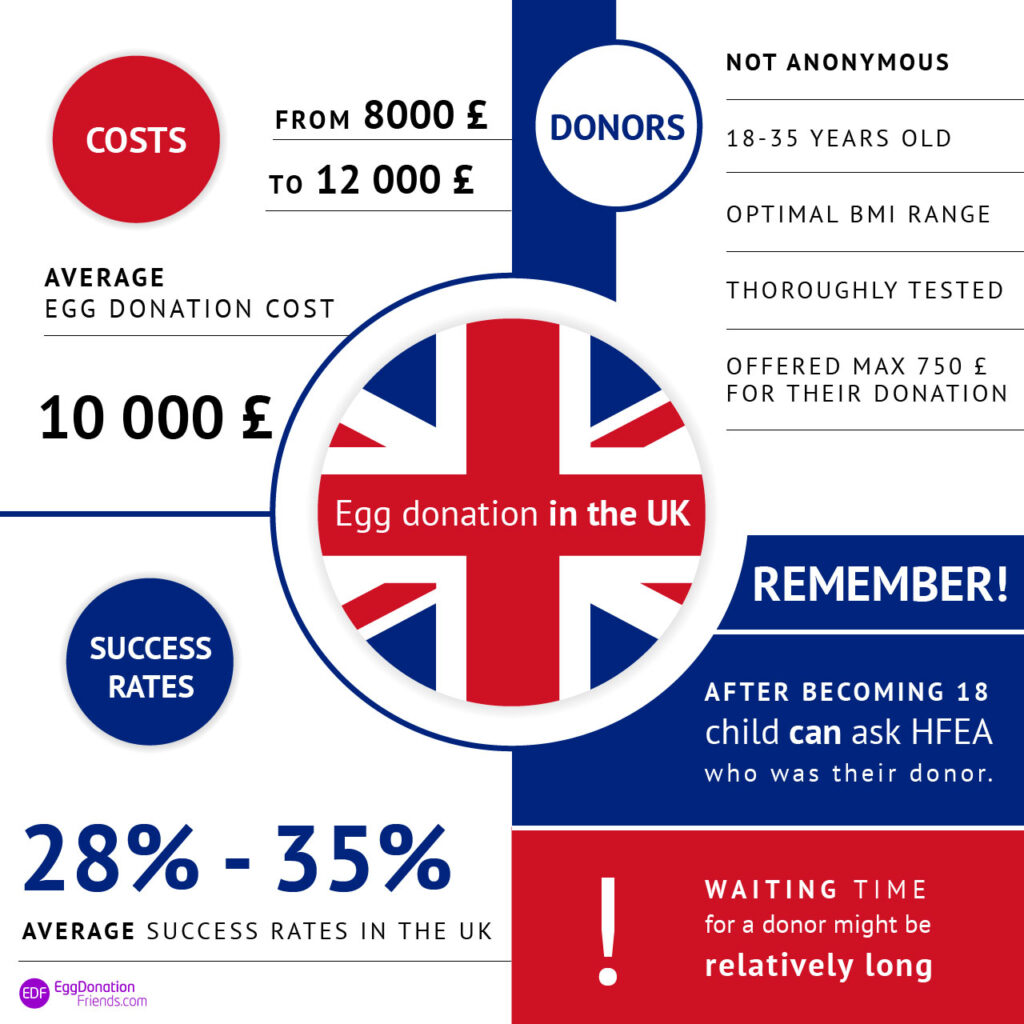
Within the United Kingdom, egg donation IVF treatment prices start at around £5,000 per cycle. This price doesn’t include additional costs, such as donor expenses, donor waiting list fees, embryo cultivation, certain medications, and/or required blood, uterine, and sperm analysis tests. As such, it’s easy to see how patients can end up with a final bill of around £12,000. Before deciding on a clinic, patients should confirm what is included in the stated price of treatment.
You may be interested in reading: Egg Donation Cost UK Guide
Egg donation treatment prices don’t appear to differ depending on location within the United Kingdom. The average advertised rate for donor egg IVF in top London, Manchester, and Edinburgh clinics, are all in a similar range of around £9,000 all-inclusive per cycle. However, do remember that every patient’s case is unique and, as with any fertility treatment in the United Kingdom or overseas, prices may differ depending on individual circumstances.
If you are interested in IVF with your own eggs in the UK, read our comprehensive guide on IVF cost UK, where you’ll find all you need to know about IVF and add-on costs in the UK.
Considering the relatively high cost of treatment, is it any wonder that patients prefer looking elsewhere? Clinics from all over Europe gladly accept visitors from the UK, offering not only lower costs, but also donor anonymity.
The main reason patients from our clinic go overseas is for egg donation. It is the price for some patients together with the anonymity that makes it a viable option but also some patients find that it’s a shorter wait time to find a match.
– Kuljit Moore-Juneja, CEO, the Surrey Park Clinic, Guildford & Putney
Are there any hidden costs in IVF with donor eggs in the UK?
When having IVF with donor eggs, be aware that there are hidden costs that can add to the overall cost. Clinics will give you a base price for the treatment but this initial quote doesn’t include medication, donor screening, genetic testing and other related costs.
Potential hidden costs may include storage costs for embryos or eggs if you store them for future use and costs for genetic testing or screening of embryos which are becoming more common in fertility treatments to give you the best chance of a healthy pregnancy.
Egg donation costs in the UK compared with other popular IVF destinations in Europe
| Egg Donation Country | Egg Donation Costs in the UK vs Europe |
|---|---|
| Egg Donation IVF in the UK | £9,000 – £12,000 |
| Egg Donation IVF in Spain | £5,000 – £9,300 |
| Egg Donation IVF in the Czech Republic | £3,800 – £6,700 |
| Egg Donation IVF in Greece | £4,200 – £6,700 |
| Egg Donation IVF in North Cyprus | £3,800 – £5,000 |
| Egg Donation IVF in Ukraine | £3,400 – £5,900 |
| Egg Donation IVF in Russia | £3,200 – £5,900 |
| Egg Donation IVF in Poland | £3,400 – £5,100 |
| Egg Donation IVF in Latvia | £4,200 – £6,700 |
Non-anonymous donors in the UK
I actually think most recipients will want the child to have the legal right to trace the donor in the future (even if they never do it). That said, even though most parents say they will tell the child about their genetic origins, I think only about 40% have told the child by the time they are 7 years old, and I think the older the child is when you start broaching the subject, the harder it is to broach it.
– Dr. Marco Gaudoin, Medical Director, GCRM Fertility, Glasgow
Since April 1st, 2005, it is a legal requirement within the United Kingdom that all egg, sperm, and embryo donors agree to be identifiable to any person or persons conceived as a result of their donation. This means that clinics submit personal data of every donor to the HFEA in accordance with this law. Currently, any person conceived via gamete donation has the right to apply to HFEA to receive non-identifying information at age 16. At 18, they can freely access all of the information the clinic submitted at the time of the donation. The transparency of donor information is an extremely important issue for some mothers conceiving with donated eggs.
Find Top Egg Donation Clinics Abroad“We wanted the chance for our child to know who her donor was in the future, as per the rules here. We felt it wouldn’t be fair for her to have no idea of where she was from genetically.”
-Patients from London
Donors can find out whether they have genetic children, but if the treatment took place at a licensed UK clinic, they have no legal rights or obligations. This means a donor will not be named on the birth certificate, can’t voice opinions over how the child is raised, or be required to provide any financial support to children produced from their donations. Donors can change or withdraw their consent at any point until the gametes are used. They can also decide how many families can be created from donated eggs, up to a maximum of ten.
When it comes to the preferences and inclinations of our recipients, I can confirm that the vast majority of couples and individuals I see wish to allow their future children to have access to the identity of the donor when they reach the age of 18. Therefore, it is the minority of couples or individuals that I see who opt to receive donor treatment abroad due to the regulations in the UK. Mostly, going for an ivf abroad is due to having difficulties recruiting a suitable donor in a timely fashion, and at times, it is due to financial considerations.
– Dr Benjamin Abramov, Medical Director, Gennet City Fertility, London
Who are egg donors in the United Kingdom?
Healthy women between the ages of 18 and 35 can donate eggs in the UK. It is a legal requirement that donors must undergo screening and some clinics also specify additional eligibility, such as a minimum or maximum BMI calculation.
In order to become an egg donor in the United Kingdom, women should be healthy and between the ages of 18-35. In accordance with the law, they undergo extensive testing for certain genetic disorders and sexually transmitted infections. Potential donors need to share their medical history and advise clinics about any known medical conditions within their family. They must also fully disclose any physical or mental issues they suffer from – failure to do so results in legal action. Women donating their eggs must also not be trying for their own pregnancy whilst undergoing treatment.
Best Countries for IVF Revealed
Popular countries, costs, success rates, legal frameworks and availability in one comprehensive 100-page guide. 10K+ downloads
Best Countries for IVF Revealed
Popular countries, costs, success rates, legal frameworks and availability in one comprehensive 100-page guide. 10K+ downloads
Find the Right IVF Clinic Abroad
Get personalised clinic suggestions, cost clarity, donor options and next-step guidance before you contact clinics.
IVF Clinics Directory
Carefully selected clinics based on patients' reviews and clinics’ experience.
Compare IVF Packages Costs
Explore comprehensive IVF packages that include treatment costs, additional services, and special offers.
There are no specific restrictions regarding the number of times a woman can donate or even the number of children which can be born from her donations, however, a maximum of ten families per donor must not be exceeded.
In the United Kingdom, donors must be identifiable to any children born as a result of their donations, and the following information must be provided; name, date of birth, current address, ethnicity, NHS number, marital status, physical characteristics, personal description and whether the donor has any children. Donors can also write a “goodwill message” to those born from their donations. This information is stored confidentially by HFEA. They can’t, however, receive any compensation higher than £750, which is meant to cover treatment costs.
At any point following the birth of a donor-conceived child, their parents can ask for the donor’s non-identifying information. This information can then be shared with the child. The children themselves can request the same information once they turn 16.
At age 18, anyone born from donated oocytes can apply to HFEA for all the donor details; including their name and last known address.
Is it difficult to find egg donors in the UK?
Finding egg donors in the UK can be challenging. There’s a shortage of donors compared to the growing demand for donor eggs. Many fertility clinics report that the number of women wanting donor eggs often exceeds the supply so waiting times are getting longer.
This is made worse by the strict criteria for potential donors which includes age restrictions (18-35), health checks and a full medical history assessment, so the pool of donors is even smaller. Becoming an egg donor requires a big commitment from potential donors, multiple clinic visits for health checks and counselling sessions.
Egg donation in the UK – the procedure and choosing an egg donor
Clinics perform the donor matching process, with donors and recipients selected on basic phenotype characteristics. These include traits such as hair and eye colour, shape, height, and ethnicity. Patients often don’t have a choice on additional factors, such as personality type or education;
“We didn’t have a choice, the donor was chosen for us based key characteristics i.e. the lady had similar skin tone, hair colour and height to me”.
– Patients from Manchester
This may differ if a private agency selects the donors instead. There are two main types of egg donors: those participating in egg-sharing schemes and those who donate altruistically. In the United Kingdom, donors receive a maximum compensation of £750 to cover their expenses.
When using the recruited egg donor, clinics often perform a synchronized fresh transfer cycle. This means that treatments for the donor and recipient run simultaneously. The usual protocol for retrieving the donated oocytes is normally the same as with any standard IVF cycle; the donor receives a dose of gonadotrophins to stimulate their ovaries. After that, surgeons retrieve the eggs and send them off for fertilization. Clinics either transfer or freeze any subsequent embryos, depending on their quality and quantity. Meanwhile, the clinic prepares the recipient for the embryo transfer.
Egg donation – UK or overseas?
| If this matters most | Main point to investigate |
|---|---|
| Staying close to home | UK treatment |
| Future access to donor identity | UK donor system |
| Anonymous donation | Spain, Greece or Czech Republic |
| Lower clinic cost | Greece or Czech Republic |
| Larger donor availability | Spain and other larger European donor programmes |
| Shorter waiting time | Compare current donor availability abroad |
| Avoiding flights and hotels | UK |
| Total budget | Compare treatment + medication + travel |
| Older patient | Confirm the clinic's individual age policy |
| Specific donor characteristics | Confirm actual current donor availability |
Comparing the UK with Greece, Czech Republic, Spain, and Portugal
When considering egg donation abroad, these countries are popular alternatives, offering competitive pricing, high success rates, and varying legal frameworks.
| Country | Typical donor egg IVF cost | Donor identity model | Main practical consideration |
|---|---|---|---|
| UK | £7,000-£12,000 | Identity can become available to donor-conceived person at 18 | Treatment close to home, but donor matching may involve longer waits |
| Spain | €5,900-€8,500 | Anonymous | Larger donor availability and generally shorter matching times |
| Greece | €4,200-€6,000 | Anonymous | Lower treatment cost and broad donor availability |
| Czech Republic | €4,300-€5,500 | Anonymous | Lower-cost donor egg programmes |
| Portugal | €6,300-€7,300 | Donor rules should be confirmed before treatment | Mid-range European treatment costs |
Find Top Egg Donation Clinics Abroad
Why do some UK patients seek egg donation abroad?
Many UK patients are going abroad for egg donation because of shorter or no waiting times and more available donors than in the UK. Fertility treatments including IVF with donor eggs are significantly cheaper in countries like Spain, Greece and the Czech Republic than in the UK.
Also the anonymity rules in the UK for egg donation mean some patients are going abroad. UK law allows donor conceived children to access identifying information about their donors when they turn 18 which some patients want to avoid.
You might be interested in reading: Why British patients go abroad?
How long is the waiting time for an egg donor in the UK?
The waiting time for an egg donor in the UK can vary widely depending on the fertility clinic and the specific requirements of the recipient. On average, patients may wait anywhere from six months to two years to find a suitable donor.
Find the Right IVF Clinic Abroad
Get personalised clinic suggestions, cost clarity, donor options and next-step guidance before you contact clinics.
Clinics with larger donor pools or partnerships with international donor banks may offer shorter waiting times, but this is not guaranteed.
How successful is IVF with donor eggs in the UK?
IVF with donor eggs in the UK is highly successful, particularly compared to traditional IVF using a woman’s own eggs, especially for women over 40. Many clinics in the UK have advanced facilities and skilled specialists, which contribute to high success rates for this procedure.
Clinics in the UK often perform thorough assessments of both donors and recipients to optimize outcomes. While the costs of IVF with donor eggs in the UK may be higher than in some other countries, the high standards of care and regulation ensure safe and effective treatment.
Are there any age restrictions for IVF with donor eggs in the UK?
There are age restrictions for IVF with donor eggs in the UK, although they can vary slightly between clinics. Individual clinics set their own eligibility policies.
It is important for women considering IVF with donor eggs to understand that their overall health and potential pregnancy risks will be assessed by fertility specialists. Clinics typically require comprehensive medical checks.
How does the cost of egg donation in the UK compare to other countries?
The cost of egg donation in the UK is generally higher than in many other countries, especially in Europe. In the UK, IVF with donor eggs typically ranges from £7,000 to £12,000 per cycle, depending on the clinic and specific services included.
In contrast, countries like Spain, Greece, and the Czech Republic often offer lower prices for egg donation, typically between £4,000 and £7,000 per cycle, depending on the clinic and services included.
What are the differences between egg donation in the UK and Spain?
Egg donation in the UK and Spain differ mainly in regulations, donor pool and cost. In the UK, egg donation is strictly regulated by the HFEA, where all donors must be identifiable to any child born from their donation when they turn 18. This openness can be attractive to some patients but may also reduce the number of donors willing to donate. In the UK donors can only receive reimbursement for reasonable expenses, which reduces the donor pool and often means longer waiting times for patients.
In Spain it’s a more straightforward process with more donors due to different regulations. Spanish law allows donor anonymity and donors are compensated financially, making donation more attractive and more available. This means shorter waiting times and often more choice of donors. The cost of egg donation in Spain is typically lower than in the UK.
Key Considerations
When evaluating IVF treatment options, particularly if you’re considering alternatives to the UK, it’s important to weigh several key factors. Success rates are crucial, and countries such as Spain and Greece often excel due to their advanced technologies and extensive donor pools. While the UK provides a strong legal framework with strict regulations, countries like Spain and Greece offer enhanced donor anonymity, which might better align with your preferences.
If you’re exploring alternatives outside the UK, accessibility is another important consideration. Countries like Spain, Portugal, Greece, and the Czech Republic offer high-quality treatment options at lower costs, making them attractive choices for those willing to travel for their care. These destinations provide viable alternatives for those seeking to balance affordability with excellent outcomes, offering a broader perspective on your IVF journey.
Considering IVF treatment beyond the UK? Our guide provides more information on IVF treatments in seven European countries, including Spain, Portugal, Greece, and the Czech Republic. It offers practical insights into treatment costs, success rates, and legal aspects, helping you make a well-informed decision.
Not sure how, where?
If you’re thinking about having your IVF treatment abroad, here’s our guide to the most popular destinations for egg donation IVF abroad. We also have a comprehensive guide to IVF egg donation process abroad ready for your enjoyment.
If you need help choosing an IVF Clinic abroad. Spare 3 minutes of your time. You will save at least a few hours.
If you are looking for an egg donation clinic abroad, use the EggDonationFriends unique patients tool – Clinic Matching Test. We analyse your needs and choose 3 overseas clinics which match your expectations. Our database of IVF centres includes only trusted fertility clinics that have experience in providing high-quality services to international patients. The suggested IVF centres will contact you directly within 3 working days. Spare 3 minutes of your time – you will save at least a few hours! Our assistance is free of charge.
Egg donation in the UK vs Abroad