Choosing a country for IVF with donor eggs involves much more than comparing treatment prices.
The most important questions are whether treatment is legally available for the patient’s circumstances, whether the patient meets the country’s and clinic’s age requirements, whether donors are anonymous or identifiable, how quickly a suitable donor can be found, and what the complete treatment package will cost.
This guide explains how to compare the most popular destinations for egg donation IVF abroad, so you can choose the country and clinic that truly fits your medical needs, donor preferences and budget.
- Which countries are most popular for donor egg IVF abroad?
- IVF Abroad – Countries Comparison
- Why do patients travel abroad for donor egg IVF?
- IVF with donor eggs abroad – which country shall I choose?
- 1. Can I legally access treatment there?
- 2. Will clinics accept a patient of my age and medical profile?
- 3. Does the donor model fit what I want?
- 4. What is the likely total cost?
- 5. Does the clinic regularly treat patients like me?
- Should I be aware of treatment quality and customer care levels abroad?
- Choosing an Egg Donor Abroad
- Anonymous vs non-anonymous donors: what changes by country?
- Your age – the maximum age of an egg recipient
- IVF Clinics for Patients over 50
- IVF with donor eggs abroad for married couples and single woman
- IVF with egg donation programs for lesbian and same-sex couples
- Egg donation abroad – costs
- The average cost of an IVF donor egg cycle in countries that are most often chosen by international patients
- The most often chosen destinations for IVF egg donation abroad based on the patient’s country of residence:
- Which countries are more relevant for different patient situations?
- If you need help choosing an IVF Clinic AbroadSpare 3 minutes of your time. You will save at least a few hours.
- IVF abroad – Frequently Asked Questions (FAQ)
- What is the best IVF clinic in Europe?
- Which country is best for IVF?
- Which country has the highest IVF success rate?
- How do I choose an IVF clinic abroad?
- Where is the most successful IVF clinic in the world?
- Which clinics offer IVF treatment for patients over 50?
- Which countries allow patients to choose an egg donor?
- Which countries offer anonymous egg donation?
- Which countries offer identifiable or open-ID egg donors?
- Which countries allow known egg donation?
Which countries are most popular for donor egg IVF abroad?
| Country | Typical donor egg IVF cost | Maximum female age | Single women | Female couples | Donor identity |
|---|---|---|---|---|---|
| Spain | €5,900-€11,000 | Usually 50; some clinics may consider up to 52 | Yes | Yes, including ROPA where eligible | Anonymous |
| Greece | €5,000-€8,000 | 54; additional qualification after 50 | Yes | Access possible subject to required legal route | Mainly anonymous; limited non-anonymous options may exist |
| Czech Republic | €4,500-€8,000 | 48 + 12 months | No | No | Anonymous |
| North Cyprus | €4,500-€6,000 | Up to 58 with additional approvals at older ages | Yes | Yes | Anonymous |
| Portugal | €6,000-€8,000 | Around 50 | Yes | Yes | Non-anonymous / identity release |
| Latvia | €5,000-€8,000 | No statutory maximum; clinic policy | Yes | Yes under applicable treatment arrangements | Anonymous |
| Estonia | €5,000-€6,000 | 50 | Yes | Eligibility should be confirmed for the treatment required | Anonymous |
| Poland | €4,000-€6,000 | No statutory maximum; clinic policy | No | No | Anonymous |
| Denmark | €7,000-€8,300 | 46 | Yes | Yes, including ROPA | Anonymous and open donation options |
IVF Abroad – Countries Comparison
The most important differences between destinations are not just price. Age limits, treatment access and donor identity rules can rule a country in or out before you even compare clinics.
| IVF law restriction comparison | |||
|---|---|---|---|
| IVF country | Age limit for patient | Single woman | Lesbian couples |
| IVF Spain | 50 (some clinics may support patients up to 52) | Yes | Yes (ROPA) |
| IVF Portugal | 49 (+364 days) | Yes | Yes |
| IVF Czech Republic | 48 plus 12 months | No | No |
| IVF Greece | 54 (over 50 additional qualification is required) | yes | Yes (only if they are treated as a single woman – a notary statement is needed) |
| IVF North Cyprus | 58 (over the age of 55, the approval of the ethics committee is required, over 45 – the Ministry Of Health approval is required) | Yes | Yes |
| IVF Ukraine | No limit (not specified by legislation, decided by each clinic individually) | Yes | No |
| IVF Poland | No limit (not specified by legislation, decided by each clinic individually) | No | No |
| IVF Latvia | No limit (not specified by legislation, decided by each clinic individually) | Yes | Yes (only if they are treated as a single woman) |
Why do patients travel abroad for donor egg IVF?
- The national law restricts access to egg donors and egg donation programmes
- The age limit of egg recipient can be higher in countries abroad – offering treatment even for patients at the age of 55
- Types of egg donor IVF arrangements. Many patients search for IVF clinics abroad because of non-anonymous egg donation policies and practices in their home country
- The high costs of IVF, IVF ICSI or IVF with donor eggs in their home country
- Fertility clinics abroad offer high-quality treatment and achieve higher IVF success rates
IVF with donor eggs abroad – which country shall I choose?
The right country is the one that fits your legal eligibility, age, donor preferences, budget and treatment needs – not simply the country with the highest advertised success rate.
Start by asking these five questions.
1. Can I legally access treatment there?
Marital status, sexual orientation and treatment type can affect access. A destination that works for a heterosexual couple may not offer the same route to a single woman or female same-sex couple.
2. Will clinics accept a patient of my age and medical profile?
Check both:
- the country’s legal position;
- the individual clinic’s own policy.
A clinic can use a stricter age limit than the maximum permitted by law.
3. Does the donor model fit what I want?
Some patients prefer strict anonymity. Others want a future child to have the possibility of accessing identifying information about the donor.
That preference can substantially narrow the destination list.
4. What is the likely total cost?
Compare the expected cost of completing treatment, not only the cheapest advertised package.
5. Does the clinic regularly treat patients like me?
Ask about experience with your age, diagnosis, treatment history and donor requirements. A country can be popular overall while a different clinic or destination is a better fit for your individual case.
Find Top Egg Donation ClinicsShould I be aware of treatment quality and customer care levels abroad?
Quality, regulation, reporting standards and patient support vary between countries and clinics. Patients should check the clinic’s authorization, treatment experience, pricing, outcome reporting and arrangements for international care before choosing treatment.
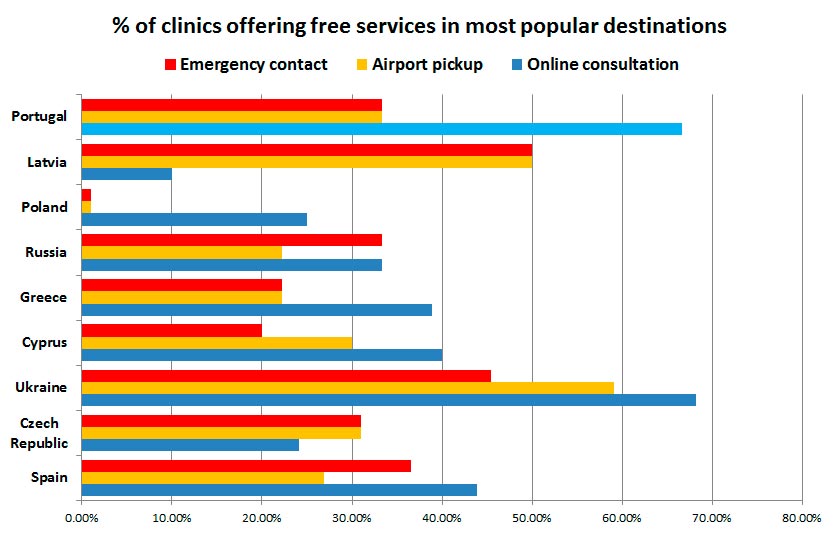
The choice of the destination depends mostly on personal preference in addition to legal restrictions on donor egg use, donor matching processes and the cost of egg donor IVF as these can all vary country by country. If you are considering undergoing egg donation in Europe, what you should pay attention to?
Professional IVF centres from various countries offer fertility treatments for international patients. Below you can find a list of the most popular destinations which allow for IVF treatment using eggs from an anonymous donor.
Choosing an Egg Donor Abroad
In most countries (e.g. Poland, Greece, the Czech Republic or Spain) the selection of egg donors is based on a phenotype matching with the recipient. This means a donor resembles the recipient in terms of eye, hair and skin colour wherever possible. These rules stem from legal requirements. This also means that in these countries patients will not be able to select “any donor”. In other countries (e.g. in Ukraine), a patient can choose a donor who looks similar to the recipient or otherwise.
According to international medical associations (ESHRE, ASRM), selecting an egg donor who shares some characteristics with a recipient is recommended -„phenotype matching”. This resemblance should at least cover the colour of hair, eyes and skin, height and a blood type.
Anonymous vs non-anonymous donors: what changes by country?
The main difference is whether the donor’s identity can ever be disclosed to the recipient or donor-conceived child.
Various clinics grant access to different amounts and types of information about an egg donor. For some patients, this may be an important factor affecting their choice of destination or an overseas IVF clinic. In Ukraine, Russia and the United States, in addition to donor’s standard features (height, weight, and hair colour), patients will get additional information including the donor’s adult/childhood photos and others. If you look for the non-anonymous egg donation cycle where they are non-anonymous because of the law – Portugal, USA and the UK are the best choices. As you can find extended information about the egg donors in Russia and Ukraine – they are still anonymous in terms of possibilities of contacting the donor.
Your age – the maximum age of an egg recipient
In most countries, the law limits the maximum age for IVF (recipients) to 49 or 50. For egg recipients who are 50 and older, there are only a very few available destinations including North Cyprus, Ukraine, Latvia, Russia (in Europe) and the USA.
IVF Clinics for Patients over 50
If you are looking for an IVF clinic for patients over 50, your treatment options may be limited. Below you will find a list of countries that allow the treatment of patients over 50 years of age. Treatment options for patients over the age of 50 do not always follow the law. In some countries, clinics themselves decide whether to treat, for example, a patient aged 55. In this case, clinics usually require, among others: additional tests and a certificate from a gynaecologist that there are no contraindications for pregnancy.
- IVF in Spain – there is an agreed limit of 50 years old, however, there are few clinics in Spain supporting patients up to 52 years old
- IVF in Greece – there is an age limit of 54 years old
- IVF in North Cyprus – over the age of 55 – up to 58, the approval of the ethics committee is required, over 45 – the Ministry Of Health approval is required – IVF clinics organize the process
- IVF in Ukraine – no limit – not specified by legislation, decided by each
clinic individually – most of the clinics set up the limit at 52-55 years old - IVF in Latvia – no limit not specified by legislation, decided by each clinic individually
- IVF in Russia – there is a limit set to 51 years old however IVF clinics may treat older patients at their own risk, there are clinics offering IVF treatment for patients up to 55 years old
- IVF Poland – no limit not specified by legislation, decided by each clinic individually – most of the clinics won’t treat women over 52 years old
IVF with donor eggs abroad for married couples and single woman
If you have a husband or a partner, the egg donor IVF programme is open to you in any country of your choice. However, if you are single, the list of overseas clinics that offer IVF or IVF with donor eggs is narrowed down to:
Find Egg Donation Clinics AbroadIVF with egg donation programs for lesbian and same-sex couples
If you are interested in undergoing IVF with donor eggs for same-sex couples, your choice of overseas destinations will be limited to:
Egg donation abroad – costs
Fertility treatment costs vary from country to country but you shouldn’t assume high costs necessarily mean better care services and higher success rates.
The most popular destinations chosen by patients from all over the world offer safe fertility treatment and high success rates of IVF with donor eggs. IVF cost abroad is usually lower than in the home country – and this is one of the reasons patients are travelling for an IVF treatment.
The average cost of an IVF donor egg cycle in countries that are most often chosen by international patients
The cost of IVF treatment abroad also varies between clinics in a given country. The differences in treatment costs can be significant. They may result from many factors, e.g. the services that the egg donation program includes, e.g. the number of eggs from the donor, additional techniques performed in an in vitro laboratory, guarantees or other. In every country you will find clinics that are very cheap and those that are very expensive. Our recommendation is to focus on the average priced clinics.
| IVF with donor eggs – cost comparison | |
|---|---|
| Egg Donation IVF in Spain | €5,900 – €11,000 |
| Egg Donation IVF in Czech Republic | €4,500 – €8,000 |
| Egg Donation IVF in North Cyprus | €4,500 – €6,000 |
| Egg Donation IVF in Greece | €5,000 – €8,000 |
| Egg Donation IVF in Ukraine | €4,000 – €7,000 |
| Egg Donation IVF in Latvia | €5,000 – €8,000 |
| Egg Donation IVF in Portugal | €6,000 – €8,000 |
| Egg Donation IVF in Russia | €3,800 – €7,000 |
| Egg Donation IVF in Poland | €4,000 – €6,000 |
The most often chosen destinations for IVF egg donation abroad based on the patient’s country of residence:
| Patient’s home country | The most often chosen destinations | Other frequently chosen destinations |
|---|---|---|
| UK | Spain, Czech Republic, Cyprus | Greece, Ukraine, Russia |
| Ireland | Czech Republic, Spain | Cyprus, Greece |
| Australia | USA, Czech Republic | Ukraine, Greece |
| Germany / Austria / Switzerland | Czech Republic, Spain, Portugal | Ukraine, Cyprus, Greece, Portugal |
| Netherlands / Belgium | Spain, Czech Republic | Cyprus, Greece |
| Norway | Ukraine, Latvia | Cyprus, Greece |
| Sweden | Czech Republic, Russia, Ukraine | Poland, Cyprus, Greece |
| Finland | Latvia, Russia, Ukraine | Czech Republic |
| Italy | Spain, Czech Republic | Italy, Portugal, Cyprus, Greece |
| France | Spain, Czech Republic | Cyprus, Greece |
| Spain | Spain, Portugal | |
| Poland | Czech Republic, Latvia, Poland | Spain, Greece |
| Russia | Ukraine, Latvia, Spain | Spain, Czech Republic, Poland |
| Canada | Spain, Czech Republic, Ukraine | Cyprus, Greece |
Which countries are more relevant for different patient situations?
| Patient situation | Countries particularly worth comparing |
|---|---|
| Single woman | Spain, Greece, North Cyprus, Portugal, Latvia, Estonia, Denmark |
| Female couple | Spain, Portugal, Denmark, North Cyprus, Latvia |
| Patient over 50 | Greece, North Cyprus, Latvia; individual clinics elsewhere |
| Anonymous donor preferred | Spain, Czech Republic, Greece, North Cyprus, Latvia, Estonia, Poland |
| Future donor identity important | Portugal, Denmark, UK |
| Lower treatment budget | Poland, Czech Republic, North Cyprus, Greece |
| Larger/diverse donor pool | Spain, Greece, North Cyprus |
| Open donation options | Denmark, Portugal, UK |
| ROPA/shared motherhood | Spain, Denmark, Portugal and other eligible destinations |
| No statutory age maximum | Latvia and Poland, subject to clinic policy |
If you need help choosing an IVF Clinic Abroad
Spare 3 minutes of your time. You will save at least a few hours.
If you are looking for an egg donation clinic abroad, use the eggdonationfriends unique patients tool – Clinic Matching Test. Our consultants will analyse your needs and choose 3 overseas clinics which match your expectations. Our database of IVF centres includes only trusted fertility clinics which have experience in providing high quality services to international patients. The suggested IVF centres will contact you directly within 3 working days. Spare 3 minutes of your time – you will save at least a few hours! Our assistance is free of charge.
IVF abroad – Frequently Asked Questions (FAQ)
What is the best IVF clinic in Europe?
The best IVF clinic in Europe is the one that will meet your expectations, giving you professional treatment options within your budget. In each of the popular IVF countries, you will find clinics that have both broad experience and great medical teams. There is no „best IVF clinic” for all patients. Each patient has different expectations and a different medical situation – that is why choosing an IVF clinic is a very individual matter. What does the term “best IVF clinic” mean? Most patients, when using this term, mean the clinic that will enable them to have children. However, remember that IVF treatment is not 100% effective – but in good clinics, a failed IVF cycle is treated as a diagnostic stage from which conclusions can be drawn for the future.
Which country is best for IVF?
The best country for IVF is the one where you can undergo IVF treatment legally and, at the same time, the one that meets your budget expectations in terms of treatment, travel and accommodation costs.
Best Countries for IVF Revealed
Popular countries, costs, success rates, legal frameworks and availability in one comprehensive 100-page guide. 10K+ downloads
Best Countries for IVF Revealed
Popular countries, costs, success rates, legal frameworks and availability in one comprehensive 100-page guide. 10K+ downloads
Find the Right IVF Clinic Abroad
Get personalised clinic suggestions, cost clarity, donor options and next-step guidance before you contact clinics.
IVF Clinics Directory
Carefully selected clinics based on patients' reviews and clinics’ experience.
Compare IVF Packages Costs
Explore comprehensive IVF packages that include treatment costs, additional services, and special offers.
Different countries regulate IVF treatment options differently – therefore not all patients can benefit from the treatment in all popular countries. In particular, pay attention to the maximum age of the patient who can be treated with IVF methods and the patient’s marital status. There are restrictions in this regard in various countries and there may be different possibilities for married couples, single woman or lesbian couples. The budget is also an important aspect as the costs of IVF in popular countries and clinics can vary significantly. For example, in Europe the costs range from 3,000 EUR to even 10,000 EUR. Besides, you should pay attention to the availability of flight connections from your country. It is worth remembering that IVF treatment is a long process and it may require several visits to the clinic abroad.
For the patients who wish to undergo IVF with donor eggs, the availability of specific type of egg donors will be an important factor. You have to remember that the availability of eggs donors varies considerably between countries.
Which country has the highest IVF success rate?
According to the ESHRE report (ART in Europe, 2016: results generated from European registries by ESHRE) which includes the data on treatment effectiveness in Europe, pregnancy rates ranged from 13.2% to 57.1% in fresh cycles after IVF or ICSI. For egg donation cycles – most cycles were carried out in Spain, Russia, the Czech Republic and Greece. Pregnancy rates per embryo transfer for cycles with fresh oocytes from a donor are 49.4% on average and for thawed oocytes – 41%. There is a high variability in outcomes for the different countries, ranging between 9.7% and 66.5% for fresh donor eggs and between 29.5% and 67.4% for frozen donor eggs.
The ESHRE report shows IVF treatment effectiveness per country – but remember that these are only statistics. In each country, there are clinics that are either more or less effective in terms of IVF treatment.
How do I choose an IVF clinic abroad?
Choosing an IVF clinic abroad is a challenge for most patients. Most of them choose the clinic basing on the opinions of their friends and acquaintances. Others are looking for information available on the Internet, e.g. on websites with clinic profiles, forums or other patients’ reviews. Regardless of how you are looking for the best clinic for you, it is worth paying attention to the following factors:
- What experience does the clinic have in treating patients with similar problems to yours?
- How many IVF cycles does the clinic perform every year?
- What is the experience of doctors and embryologists in the clinic?
- How easy it is to contact the clinic – is the clinic responsive or is the contact difficult?
And then, if you find the clinic that meets your expectations, always ask what success rates you can expect in your individual case, taking into account your treatment history and the cause of infertility. In case of Europe, patients most often choose IVF clinics in Spain, the Czech Republic, Greece, Cyprus, Ukraine and Russia.
Where is the most successful IVF clinic in the world?
In each of the popular IVF destinations, there are IVF clinics which have high treatment effectiveness for certain groups of patients. You can find clinics offering good treatment results in Spain, Greece, Czech Republic, Cyprus, Ukraine, Russia and many other IVF destinations abroad. However, there is no single best IVF clinic with the highest treatment effectiveness for all patient groups.
Which clinics offer IVF treatment for patients over 50?
IVF treatment in popular countries is regulated by law. Patients over 50 can be treated in North Cyprus (up to 58 years of age). In Ukraine, Latvia and Poland – there are no legal provisions regulating the maximum age of a woman so IVF clinics independently decide up to what maximum age they offer IVF treatment- usually until around 55 years of age. In other popular destinations, IVF treatment is usually limited to the age of 49-50.
Which countries allow patients to choose an egg donor?
It depends on the country’s anonymity model. In the strict-anonymity countries – Spain, the Czech Republic and Greece – you generally cannot pick your own donor.
The medical team selects the donor for you, matching on physical characteristics, and you never see photos or browse profiles.
Where you get more say is in countries with extended donor profiles: Ukraine, Russia and the USA typically let you see much more (including adult and childhood photos) and give you real input into the choice. North Cyprus sits in between – still anonymous, but clinics usually share fuller non-identifying profiles (personality, education, hobbies) than Spain or Greece.
So if actively choosing your donor matters to you, look toward North Cyprus or the USA. If you’re comfortable letting expert matching do the work, Spain, Greece and the Czech Republic are excellent.
Which countries offer anonymous egg donation?
The main strict-anonymity destinations are Spain, the Czech Republic, North Cyprus, Latvia and Poland. Greece is also anonymous, with limited non-anonymous options at a few clinics. In all of these, the donor’s identity is never disclosed to you or to the child.
Find the Right IVF Clinic Abroad
Get personalised clinic suggestions, cost clarity, donor options and next-step guidance before you contact clinics.
Spain is the most popular of the group – it performs over half of Europe’s donor-egg cycles, precisely because strict anonymity attracts patients who want full confidentiality and it has the largest donor pool.
You’ll still receive non-identifying information (physical characteristics and more), and the clinic matches you to a suitable donor. One honest caveat worth knowing: with home DNA-testing services like 23andMe and AncestryDNA now widespread, legal anonymity can’t fully guarantee lifelong anonymity – a determined donor-conceived person can sometimes trace genetic relatives independently, and current law doesn’t address this.
Which countries offer identifiable or open-ID egg donors?
If you want a donor whose identity your child can access later, the leading options are Portugal, the UK and Georgia. Portugal switched to non-anonymous donation in 2018, so the child can access the donor’s identity at 18. The UK has mandated identity-release since 2005. Georgia is the most open – full passport data can be available.
Some countries run mixed systems offering both anonymous and open donation, letting you choose: Denmark (the most transparent EU model), Ukraine and the USA.
Open-ID is often the deciding factor for patients who feel strongly that a donor-conceived child should be able to learn their genetic origins. It’s a personal decision with no right answer – an independent donor-conception counsellor can help you weigh it up.
Which countries allow known egg donation?
Known donation – where the donor is someone you already know, like a friend or relative – is far less common in Europe, because most popular destinations are built around anonymous donation and don’t permit it.
In the strict-anonymity countries (Spain, Czech Republic, Greece, North Cyprus, Latvia, Poland), a known donor is generally not allowed, because it breaks the confidentiality the law requires. Spain has one narrow exception: within a legally married lesbian couple doing ROPA, one partner can donate eggs to the other – but a sister or friend donating is not permitted.
Known donation is more feasible in countries with open or mixed systems, such as the USA and the UK, where the legal framework already allows the donor’s identity to be known. If a known donor is important to you, you’ll need to choose a jurisdiction that permits it – most European fertility-tourism destinations don’t.