Considering IVF with donor eggs is a big step, and one important choice is whether to use fresh or frozen donor oocytes (eggs). Both options can lead to successful pregnancies, but they differ in process and practical considerations. In this guide, we’ll compare fresh vs. frozen donor eggs – sharing up-to-date success rates, pros and cons from a patient’s perspective, and recent trends that have narrowed the gap between the two approaches. Our goal is to help you feel informed and supported as you explore what’s best for your family.
Understanding Fresh vs. Frozen Oocytes from Egg Donor
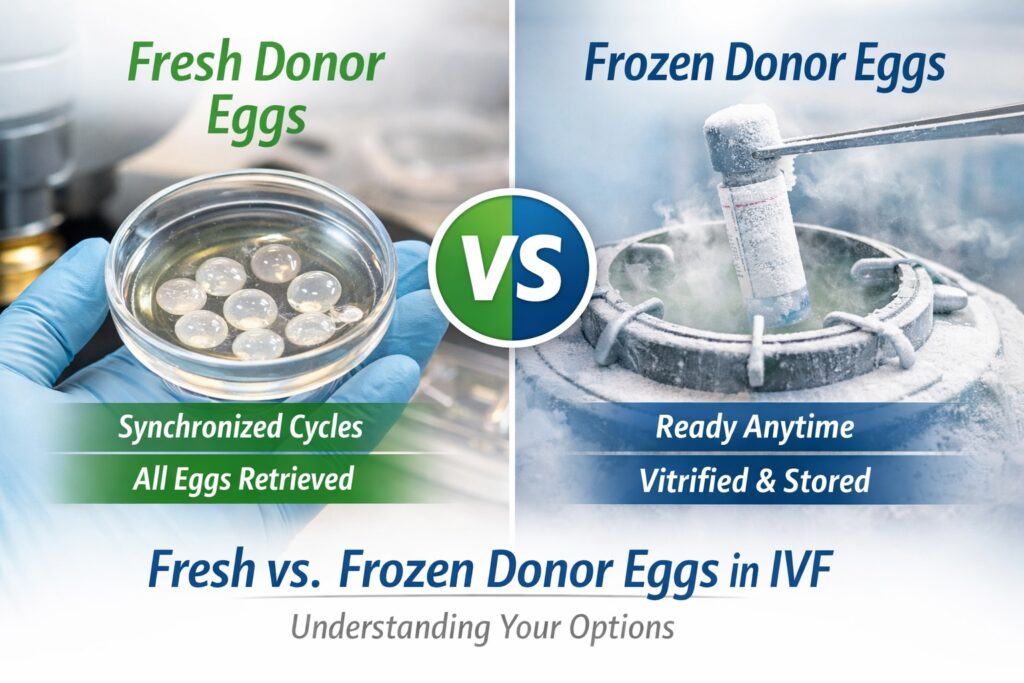
Fresh donor eggs are retrieved from a donor and fertilized immediately for your IVF cycle. This means coordinating the donor’s cycle with the recipient’s – the donor undergoes ovarian stimulation and egg retrieval, and the eggs are fertilized with sperm (from a partner or donor) right away. Any resulting embryos can be transferred to the uterus (often within days as a “fresh” embryo transfer) or frozen for later use. The key benefit is that you typically receive all the viable eggs retrieved from that donor’s cycle, which can be a dozen or more in many cases. This could yield multiple embryos and potential chances for siblings. However, a fresh cycle requires careful timing and planning: both donor and recipient’s schedules (and biology) must align, which can take time and coordination.
Frozen donor eggs are eggs that were previously retrieved from a donor, then preserved via vitrification (a rapid-freezing technique) and stored in an egg bank. When you choose frozen eggs, the donor’s part is already completed. You select a batch of frozen eggs (often around 6–8 eggs) which are then thawed and fertilized. The main perk here is convenience and speed – you don’t need to synchronize with a donor’s cycle, so the process can start as soon as you’re medically ready. Frozen eggs also allow access to a wider variety of donors (they can be shipped from anywhere), making it easier to find your ideal donor without geographic or timing constraints. In the past, freezing eggs was less effective, but today’s vitrification technology gives frozen eggs a high survival rate (around 95% survival after thaw for eggs from young donors ). This means using frozen eggs has become a reliable option for hopeful parents.
In summary:
- Fresh donor cycle:
Donor and recipient are coordinated in real time. You may get all eggs retrieved from one donor, which can mean more embryos and possibly higher upfront cost. Requires more planning and timing, but no freeze/thaw step for the eggs. - Frozen donor eggs:
Eggs are vitrified and stored before you even begin. You purchase a set number of eggs (usually fewer than a full fresh cycle yield), but you can start your cycle on your own schedule. There’s a thaw step involved, but modern vitrification has made egg freezing very effective, greatly narrowing the performance gap between frozen and fresh eggs.
Both fresh and frozen donor eggs are used around the world. In some regions, fresh donations have been the traditional approach, while in others (like the United States) the use of egg banks and frozen donor eggs has become extremely common. In fact, the use of frozen donor eggs in the U.S. has skyrocketed over the last decade – rising from about 20% of donor egg cycles in 2013 to over 68% by 2020 . This reflects how advances in freezing have made donor eggs more accessible globally. No matter which route you consider, it’s important to know that both options can offer excellent success rates and healthy babies. Let’s look at those success rates next.
Are fresh donor oocytes better than frozen donor oocytes?
When you’re hoping for a baby, the most pressing question is often: Which option gives us a better chance of success? The good news is that donor eggs overall have high success rates, because donors are typically young and healthy. In fact, roughly half of all donor egg IVF cycles result in a live birth . That figure is much higher than average IVF success rates with patients’ own eggs, especially for women in their late 30s or 40s. With donor eggs, age-related infertility factors are largely overcome.
Success Rates: Fresh vs. Frozen Donor Eggs
Comparing fresh vs. frozen eggs: Historically, IVF with fresh donor eggs showed slightly higher success rates than frozen eggs. Some years ago, freezing techniques were less advanced, and eggs might not survive the freeze-thaw process as well. However, with vitrification becoming standard around 2012 , the gap has greatly narrowed.
Many recent studies and reports show minimal differences in live birth rates between fresh and frozen donor eggs:
- According to SART (Society for Assisted Reproductive Technology) 2022 data, live birth rates per cycle using fresh vs. frozen donor eggs were essentially identical – about 39.2% vs. 38.9% respectively . In other words, statistically no meaningful difference in success was seen in that large national dataset. This suggests that by 2022, frozen donor eggs performed on par with fresh in terms of delivering a baby.
- CDC national data tell a similar story, though the exact percentages can vary depending on how they’re measured. For example, one report of finalized 2021 U.S. data showed a live birth rate per transfer of about 53.5% with fresh donor eggs vs. 45.8% with frozen donor eggs . This indicated a modest advantage for fresh eggs at that time. But remember, this kind of statistic (per embryo transfer) doesn’t count cycles where no transfer occurred. When measured per cycle started (including canceled cycles), the numbers tend to be a bit lower. Indeed, the most current approach is to track success per cycle initiated – and by that measure, as noted above, fresh and frozen are nearly the same (~39% per cycle in 2022) .
- A recent analysis of U.S. IVF outcomes from 2018–2020 did find fresh donor eggs having a slightly higher success probability than frozen, but the difference was only on the order of a few percentage points. In that study, live birth rates for fresh donor eggs were around 46–56%, versus about 41–46% for frozen donor eggs (depending on whether embryos were transferred fresh or frozen) . Such differences have been shrinking as freezing techniques improve.
The bottom line: Both fresh and frozen donor eggs offer high success rates, often much higher than standard IVF with non-donor eggs. Fresh cycles historically had a slight edge, but recent data from fertility authorities show that vitrified (frozen) eggs can achieve virtually the same live birth rates as fresh eggs in many programs . Any remaining gap is small – for many patients, it may be more important to choose the option that fits their needs (timing, availability, etc.) rather than chasing a minor percentage difference in success.
Note on how success rates are reported:
When comparing numbers, be aware of what is being measured. Some sources quote “live birth per embryo transfer” (which counts only cycles where an embryo was actually transferred), while others use “live birth per cycle started” (which includes every IVF attempt even if it doesn’t reach transfer). The per transfer rate will always look higher, because it ignores cycles that were canceled or had no transferable embryos . For example, if a clinic reports a 50% live birth rate per transfer, the rate per cycle started might be a bit lower (perhaps 40–45%, accounting for those extra failed attempts). Organizations like SART and CDC have shifted toward reporting per cycle to give a more realistic picture of the chances including the full process and the effort involved . So when you see success statistics, make sure you’re comparing apples to apples. In the context of donor eggs, many cycles do lead to a transfer (since donors are young and typically produce embryos), so per transfer and per cycle rates can be fairly close. Still, it’s good to clarify which metric is being used so you understand your odds correctly.
Fresh vs. Frozen Oocytes – Pros and Cons
Choosing between fresh and frozen donor eggs isn’t just about success rates. There are practical and emotional factors that matter to patients. Here we outline some pros and cons of each from a patient-centric perspective:
- Availability & Donor Matching:
With fresh donor eggs, you need to find and match with a specific donor, who then undergoes an egg retrieval for you. This can mean a longer wait – it might take time to identify the right donor and then coordinate schedules. In contrast, frozen donor eggs are usually ready and waiting in a clinic or egg bank. This often makes the process faster and gives you access to a broader selection of donor profiles (since eggs can be transported from different locations). - Convenience & Planning: Using frozen eggs is generally more convenient. There’s no need to synchronize your cycle with the donor’s or worry about the donor’s timing. You have flexibility to plan the embryo transfer when it suits your body and schedule. This can reduce stress, as you’re largely in control of the timeline. With fresh eggs, however, the treatment timeline is tied to the donor’s cycle. You and your donor will have to follow a strict schedule for monitoring, medications, and the retrieval. Any unexpected hiccup (like a donor’s cycle not responding as expected) could delay the process. Many patients appreciate the shorter preparation time that frozen eggs afford – an IVF cycle with frozen eggs might take only a couple of months total , whereas a fresh donor cycle can span several months to arrange, complete screening, and synchronize.
- Number of Eggs & Embryos:
In a fresh donor cycle, since you may receive all the eggs retrieved from the donor, you often get a relatively large number of eggs – frequently 15 or more, depending on the donor’s response . This can translate to multiple embryos, some of which can be frozen for future use (e.g. for a second child). For families wanting more than one child, a fresh cycle might yield enough embryos for siblings without needing another donor cycle. With frozen eggs, you usually purchase a smaller batch (often around 6 eggs) . Not every egg will fertilize or develop, so a batch of 6-8 eggs might lead to a few embryos. It may be perfectly sufficient for one child, but there might be fewer (or no) extra embryos to freeze. Some egg banks allow you to buy more oocytes if needed, but that increases cost. In short: fresh cycles can offer quantity (more chances), whereas frozen eggs offer control (you can start with a set number and always get more later if needed). - Success and Medical Considerations:
Medically, both options are safe and well-established. A fresh egg has never been frozen, so there’s no exposure to the freeze-thaw process. A frozen egg must survive thawing, but as noted, vitrification yields very high survival rates (~95% for young donors’ eggs) . The slight drop in success rates with frozen eggs (if any) is often attributed to the fact that a few eggs may not survive or fertilize as well after thaw. That said, clinics experienced with frozen eggs handle them expertly, and outcomes are now very close to fresh. Some doctors still consider a fresh donor cycle the “gold standard” for maximizing success (since you typically have more embryos and avoid any freeze-related loss), but others point out that a well-vitrified frozen egg is nearly as good as fresh – especially given how embryo freezing is common even in fresh cycles. (For example, many clinics will freeze embryos for transfer in a later cycle, even if the eggs were fresh, to allow genetic testing or to optimize the uterine lining timing. So either way, some freezing often comes into play.) One possible medical advantage of frozen eggs is that the recipient’s cycle can be prepared independently, potentially leading to a more controlled endometrial lining development since you’re not rushing to sync with a donor. In terms of health of the baby, studies have found no difference in obstetric outcomes – babies from frozen donor eggs are just as likely to be full-term and healthy as those from fresh donations . - Cost Factors: The cost of donor egg IVF varies widely by country and clinic, but there are some general trends. A fresh donor egg cycle often involves paying the donor’s compensation, agency fees, and the entire IVF process for that donor’s cycle – which can be quite expensive, though you get many eggs for that price. Frozen donor eggs are often sold as a package for a set fee, which can appear cheaper (since you’re not funding a full fresh cycle for the donor).
For example, one U.S. egg bank cites around $28,000 for a fresh donor cycle vs. ~$19,500 for a frozen egg cohort (not including the IVF lab costs) while in Europe the egg donation packages are in the range of €6,000 to €9,000 (including all IVF lab costs).
However, keep in mind that with frozen eggs you might need to purchase a second batch if the first doesn’t yield a successful pregnancy, which would add to the cost. Some patients also invest in guarantees or refund programs. From a budgeting perspective, frozen eggs let you spread out costs (pay per batch as needed), whereas a fresh cycle is a larger one-time investment but with the potential of more embryos. It’s wise to consult with your clinic and perhaps a financial counselor to understand the full cost picture for your situation.
In weighing these pros and cons, consider your own priorities and circumstances. If timing and flexibility are crucial (for instance, you need to proceed quickly or you can’t easily coordinate schedules), frozen eggs might be more appealing. If having a higher number of embryos or the possibility of genetic siblings from one donor is most important, a fresh cycle might be worth the extra effort and cost up front. Both paths can be emotionally and physically demanding, so there’s no one-size-fits-all answer – the “best” choice is the one that aligns with your needs, with guidance from your medical team.
Understanding Success Rate Reporting: Per Transfer vs. Per Cycle
It’s worth revisiting the topic of how success rates are reported, because you might see clinics or sources quoting different numbers and it can be confusing. The reporting methods have evolved in recent years. Previously, many clinics touted “pregnancy rates per embryo transfer” – basically, of those who had a transfer, how many got pregnant or had a baby. This number looks good because it filters out those cases where the cycle didn’t make it to transfer (for example, if a donor didn’t produce eggs or embryos failed to develop, that scenario wouldn’t count in the per-transfer calculation). Now, however, organizations like SART and CDC emphasize “live birth rate per cycle started.” This includes all cycles in the denominator, even ones that were canceled or had no embryos to transfer .
Why the change? It gives a more honest picture of what a patient going through IVF can expect. It accounts for the full treatment burden – if you had to start two cycles to get to one embryo transfer, that matters in understanding the effort and cost involved . For example, suppose 100 recipients start a donor egg cycle. If 5 of those cycles are canceled (no viable eggs or embryos), and the other 95 go to transfer and 50 result in live births, the per transfer success rate would be 50/95 = ~53%, but the per cycle started success rate is 50/100 = 50%. The difference isn’t huge in this case, but it’s there. In other scenarios (such as IVF with one’s own eggs, where cancellation rates are higher), the gap can be bigger.
You may be interesting in reading: Donor Egg IVF Success Rates – The Truth Clinics Don’t Tell You
For donor eggs, as mentioned, the cancellation rates are relatively low because donors are screened and tend to be productive. Still, when you read data like “fresh donor eggs have a 65% success rate” versus “40% success rate per cycle,” know that those might both be accurate – they’re just measured differently. Always check if it’s per cycle, per transfer, or even an IVF cumulative rate (sometimes clinics give a cumulative chance of success if you do 2–3 cycles). Understanding this context will help you interpret the numbers without undue alarm or false optimism. The encouraging reality is that however it’s measured, donor egg IVF generally has higher success probabilities than many other fertility treatments – but it may take more than one try, and that’s normal.
Fresh and Frozen oocytes – What influences the success of IVF with donor eggs?
While the fresh vs. frozen question is important, other factors can be just as crucial to your success and experience. Here are a few considerations to keep in mind:
- Egg Donor Quality:
Regardless of fresh or frozen, the characteristics of the egg donor matter a lot. Donor age is a big predictor of success (most donors are in their 20s, which is ideal). Health and fertility history, genetic screening, and the number of eggs the donor can provide are all important. A high-quality donor (young, proven fertility or prior successful donations, excellent medical history) will likely yield good embryos whether you use her eggs fresh or frozen. When evaluating programs, look at how they screen donors and what information they provide about them. - Laboratory and Clinic Standards:
The IVF laboratory’s expertise can impact outcomes significantly. Labs vary in their experience with thawing frozen eggs, culturing embryos, and performing delicate procedures like ICSI (intracytoplasmic sperm injection, often used to fertilize eggs especially after freezing). A top-notch lab will have high fertilization and blastocyst development rates with both fresh and frozen eggs. Similarly, the clinic’s protocols – how they prepare the uterine lining, how they handle embryo transfers, etc. – contribute to success. When researching or talking to clinics, it’s reasonable to ask about their experience with donor egg cycles, frozen egg thaw survival rates, and overall live birth rates. According to fertility experts, differences in clinic skill and protocols can sometimes be a bigger factor than whether an egg was fresh or frozen. - Medical Team Experience:
You’ll want an experienced, compassionate team guiding you. Clinics that routinely handle donor egg IVF (and especially those familiar with egg banks) will be adept at the unique aspects of these cycles. An experienced team can also help you weigh the trade-offs – for example, advising if your situation (perhaps related to your uterus or immune issues) might favor one approach or another. Beyond just clinical skill, consider the support the clinic provides: good patient counseling, clear communication, and emotional support services can make the journey much smoother . Success rates are important, but so is how the clinic makes you feel during the process. - Regulatory and Regional Differences:
If you’re looking internationally or considering cross-border options, be aware that laws and practices differ. Some countries only allow anonymous donation, others allow known donors; some places have well-established egg banks, others rely mostly on fresh donation programs. These differences can affect your choice. For instance, in places where frozen egg banks are less common, you might have more limited frozen options and thus lean toward a fresh donor recruited for you. Conversely, in the U.S. and many other countries, frozen donor eggs are readily available and commonly used in IVF cycles . Make sure you understand the norms and success rates in the context of where you’re undergoing treatment. A globally relevant perspective shows that, overall, donor egg IVF is widely successful, though reported success percentages can vary across national registries. The key is to choose a reliable clinic or agency wherever you are.
Download our IVF guide to understand differences in popular destinations: IVF Abroad – Patient’s Guide - Personal Priorities and Gut Feelings:
Finally, consider intangible factors. Some patients simply feel more comfortable with one approach. For example, you might value having a direct connection to your donor (fresh cycle), or you might prefer the sense of certainty that comes with having eggs in hand (frozen). Stress levels can impact your experience, so if one path gives you more peace of mind, that’s important. Neither choice is “wrong” – they’re different routes to the same goal.
Conclusion: Support in Your Decision
Deciding between fresh and frozen donor eggs is a personal decision, and it’s normal to weigh a lot of factors – success rates, timing, availability, cost, and your own comfort. The reassuring news is that both options have helped thousands of patients become parents, with excellent success. Thanks to modern techniques and standards, frozen donor eggs now rival fresh eggs in live birth rates, and both can give you a strong chance at a healthy baby . The differences lie more in practical considerations than in the ultimate outcome.
As you make your choice, lean on your medical team’s experience – ask them about their success rates with fresh vs. frozen, and discuss what fits your situation. Remember to interpret success statistics with care (know whether you’re looking at per transfer or per cycle rates, for instance) and keep the focus on what’s right for you. Sometimes, factors like the right donor match, a trustworthy lab, and a supportive clinic environment will outweigh the fresh vs. frozen question.
Finally, be kind to yourself throughout this process. It’s understandable to feel anxious or overwhelmed, but knowledge is empowering. Both fresh and frozen donor egg IVF are tried-and-true paths to parenthood. With a quality donor, a skilled clinic, and the advances of vitrification on your side, you truly can’t go wrong. Take the time you need to decide, gather data from credible sources (e.g. SART, CDC, ESHRE reports), and don’t hesitate to seek support – whether from fertility counselors, support groups, or others who have walked this road. Your dream of having a baby is absolutely achievable, and whichever method you choose, you deserve compassionate care and the best possible information. Here’s to hopeful beginnings and the family that awaits you.
Need help choosing an IVF clinic abroad?
Spend just 3 minutes now and save yourself hours of searching later.
Take 3 minutes to complete our Clinic Matching Test and save yourself hours of searching, comparing, and contacting clinics on your own. Tell us what matters most to you — your treatment type, destination preferences, expectations, and personal situation — and we will match you with 3 trusted IVF clinics abroad that fit your needs. Our database includes only experienced fertility clinics that regularly support international patients and understand what matters during treatment abroad: clear communication, transparent information, patient care, and professional support. The selected clinics will contact you directly within 3 working days, so you can compare your options and take the next step with more confidence.

Table of Contents
- 1 Understanding Fresh vs. Frozen Oocytes from Egg Donor
- 2 Are fresh donor oocytes better than frozen donor oocytes?
- 3 Success Rates: Fresh vs. Frozen Donor Eggs
- 4 Fresh vs. Frozen Oocytes – Pros and Cons
- 5 Understanding Success Rate Reporting: Per Transfer vs. Per Cycle
- 6 Fresh and Frozen oocytes – What influences the success of IVF with donor eggs?
- 7 Conclusion: Support in Your Decision