
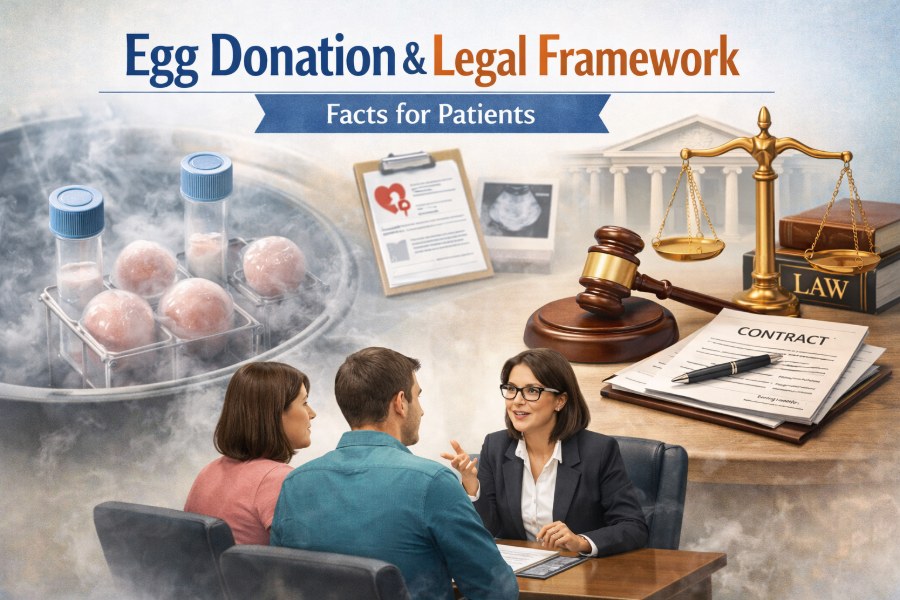
Egg donation is a voluntary and completely anonymous act that women choose to undertake in order to help other women become mothers. It is a controlled medical process consisting of five phases.
What is the Egg Donation Process Like?
At IVI, the donor’s well-being is always the priority. For this reason, the process is carefully always supervised by specialists to ensure safety and quality. The first step is an initial consultation, during which an interview is conducted to assess the candidate’s health status and medical history, as well as to answer any questions clearly and without obligation.
Subsequently, medical tests are performed to confirm that the candidate is in good health and not exposed to any risk. These tests include genetic analysis, blood tests, an ultrasound scan, a gynecological examination, and a psychological assessment.
Once it is confirmed that the donor is eligible, ovarian stimulation begins. This process lasts between 10 and 12 days and consists of hormonal treatment administered through a series of injections that help the ovaries produce a greater number of eggs. During this period, the donor attends the clinic on a few occasions so that specialists can monitor how the treatment is progressing.
When the oocytes are ready following stimulation, follicular puncture is performed to retrieve them. The procedure takes place in the operating room under sedation to avoid discomfort, and within two to three hours patients can return home the same day, without the need for hospitalization.
Dr Nina Wegmann, gynecologist at IVI Madrid, says: “Finally, follow-up care is carried out to ensure that the donor remains well throughout the entire process and after the donation, as at IVI the well-being of donors and patients is our foremost priority”.
How are Donors Selected?
As mentioned previously, the first stage of the donation process is donor selection, which is highly rigorous and guarantees maximum safety and treatment quality. At IVI, only 4% of candidates who wish to donate ultimately become donors. Each candidate must undergo a comprehensive evaluation process that includes full medical examinations, genetic analyses, gynecological tests, blood tests, and a psychological assessment, in addition to a detailed review of personal and family medical history.
This process ensures that donors meet the highest medical and ethical standards, offering patients maximum confidence and reducing potential risks.
What Does the Law Say About Donation? Is There Legal Certainty?
Egg donation is regulated by clear and well-established legislation in Spain, designed to protect both patients and donors. The law establishes that donation is voluntary, anonymous, and confidential, thereby guaranteeing privacy and legal certainty for all individuals involved. Furthermore, authorized clinics follow strict medical, ethical, and quality protocols to ensure that the process is safe and transparent.
Spanish legislation also provides for the SIRHA registry (Sistema de Información de Reproducción Humana Asistida), a system that monitors the number of donations and births per donor, ensuring compliance with legal limits. In addition, it safeguards the anonymity of donors and patients, enables full traceability of gametes and embryos, and incorporates a biovigilance system that helps detect potential genetic risks and act promptly if necessary.
What is the ROPA Method?
Among the available treatments is the ROPA method (Reception of Oocytes from the Partner), specifically intended for female couples. This approach allows one partner to provide the egg while the other carries the pregnancy. It enables both women to participate actively in the process and to share a biological connection with the future child.
Perfect Match 360º: Biometric and Genetic Matching
One of the main concerns for patients is compatibility with the donor. For this reason, IVI has developed Perfect Match 360º, an advanced system that enables selection of the most suitable donor through a comprehensive analysis combining physical, biometric, and genetic criteria. “This process takes into account characteristics such as blood group and physical resemblance, in addition to facial biometric analysis that evaluates thousands of reference points to identify a donor with a high degree of similarity,” explains Dr. Nina Wegmann, gynecologist at IVI Madrid.
A genetic test is also performed to assess compatibility between donor and recipient and to reduce the risk of transmitting more than 600 genetic diseases. This comprehensive approach allows for more personalized treatment and provides greater reassurance and confidence to patients.
Why is Spain a Reliable Option for German Patients?
Many international patients choose to undergo treatment in Spain due to the legal situation in their home country, the extensive medical experience available, and access to specialized treatments. Spain has a long-standing track record in assisted reproduction and offers a safe, regulated environment with high medical standards.
Clinics such as IVI have become a trusted option for international patients thanks to their specialization and patient-centered approach. In addition, they have a large egg bank, making it possible to offer treatment with little or no waiting list. This allows patients to begin the process without unnecessary delays and with the support of a highly experienced medical team. IVI also offers online consultations to minimize travel and coordinates with physicians in each patient’s country of origin, ensuring continuous and personalized follow-up throughout treatment.
Conclusion
Spain has become a leading country in assisted reproduction, particularly for international patients seeking safe and effective treatments. This is due to several key factors, including clear legislation, extensive medical experience, and the use of advanced fertility technology.
One of the most important aspects is the strict regulatory framework that protects patients and guarantees treatment quality. In addition, donor selection processes are highly rigorous and include comprehensive medical and genetic assessments. This makes it possible to achieve the best possible compatibility through advanced biometric and genetic matching systems, increasing safety and the likelihood of success.
Thanks to this combination of experience, technology, and personalized care, many women and couples — including international patients from countries such as Germany — choose Spain for their fertility treatment. The support of specialized medical teams throughout the entire process helps patients feel informed, secure, and supported at every stage of their journey toward motherhood.
Table of Contents